

Why “Research” Feels Everywhere
On the Taylor Swift Dubai Chocolate Labubu Industrial Complex, Knowledge Influencing, and the philosophy of mediaton. And why what appears as expansion may, in practice, be a narrowing of form.

Research. Research. Research. The once-boring activity is now developing a new cool-girl persona. Substack articles and video essays galore reflect on research as a leisure activity, research as pattern disruption, research as a cultural process. On the other side of the coin, conspiracy theorists demand that we “do our own research,” while they build their webs of conspiracy further and further.
Research in the digital age has taken on a new meaning. This is because we can all talk to one another, and publishing is available to all, at least in theory. The interfaces through which this new definition has taken hold — social media, newsletters, blogs, reddit threads — mediate how this definition has developed. This is why research feels everywhere.
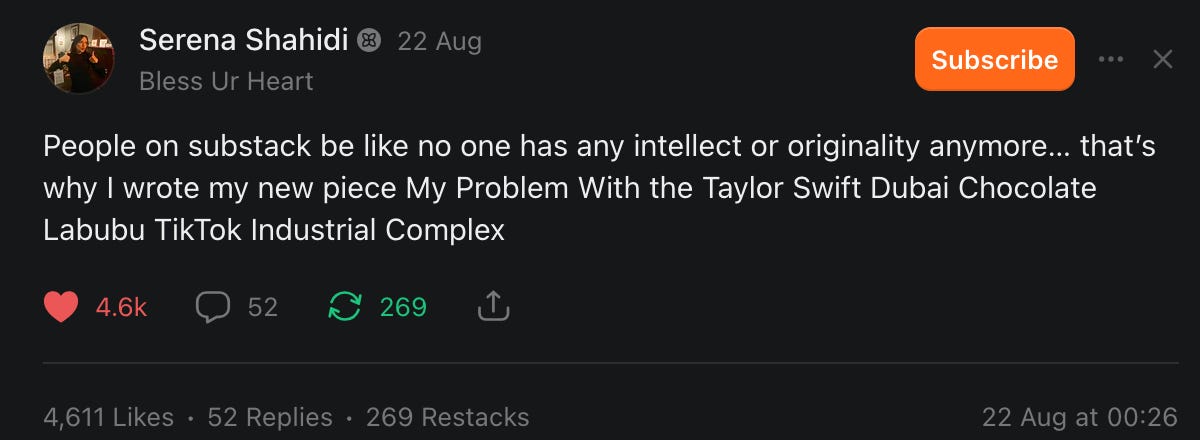
In contrast to feeling everywhere, however, research also feels “off.” This is something many have noticed, and came to the same platforms to critique (yes, that is what i am doing now, bear with me). The “Taylor Swift Dubai Chocolate Labubu Industrial Complex” is a note I reference a lot in relation to this. People opine about the performative-pseudo intellectual and all the hot men reading bell hooks to get girls.
What I have explored in this essay is a little different. What we see is the expansion of the activity of research, whilst its form is narrowing. But why is this? It all has to do with the metaphors we use to (mis)understand the nature of the digital interface. As a UX designer, I find this fascinating.
Knowledge Influencing
“Knowledge influencing” describes the hot new niche of those influencers who create a platform by posting educational videos, often about politics or philosophy. This is part of my own work, through the IRRATIONAL TECHNOLOGY tiktok channel. But, as I outlined in my essay the collapse of online education is upon us, I have my qualms about the social impact of this kind of social media content.
Social media (and, data capitalism more broadly) benefit and operate from the replication of emotions through “artificial” means. What this means is that social media can draw you in by replicating the feeling of learning — or the feeling of activism — without actually contributing to your learning (or activism) in a material sense.
The feeling of research, and the new persona it comes with, are part of this affect oriented ecosystem. The feeling of having found out some new information for yourself is a good hook - one continued by the social validation of presenting this information to others in a way that makes you seem cool. But, this form of research, which is the dominant form we engage with online, is rooted on two main motivations — affect and social standing. This inherently limits outcomes, narrows topics, and can encourage confirmation bias.
Research, then, has expanded. More of us are doing it. But this expansion is also the cause of the same-ness we all feel, where every other “take” online is repetitive and shallow. This shallowness is often attributed to The Algorithm, our evil tech overlords, or the manner in which social media has completely flattened expertise.
The real problem, however, is a little more subtle than that. These effects are symptoms of a deeper problem to do with how we think about mediation, interfaces, ideology, and truth. The tech lords who benefit from these assumptions are merely along for the ride, not the creators of this reality.
Deconstructing the “Door” Metaphor
As far back as Aristotle, it has been common to think of “mediation” as a door, a threshold, or a window. This has translated into the way we think about interfaces, with the same “door” metaphors becoming prevalent in cultural criticism of all forms of digital interfaces. This door analogy implies that the information we see on our screen is simply a true representation of something — all the interface is doing is displaying information,
But, interfaces do not simply display information — they translate it. The information you see on the screen has undergone a regime of translation from electronic signals, to code, to the designed interface. What we see as “true” in the interface is manufactured coherence from messy plurality to a single, stabilised form. The interface, like any kind of mediation, acts more as layers of translation than a mere threshold.
These layers of translation mean that the information put in and through interfaces ends up producing a similar quality. Unique inquiries, thoughts, and knowledge become narrower and narrower as they pass through these translations, on top of which are algorithms, social media formats, and social biases. “Research” converges into a small set of interface-compatible actions.
The metaphors we use to understand the world around us are important; they form our very sense of self. This is why we have to understand that the interface is not a neutral mediation tool. This may seem common sense, but the prevalence of this metaphor in the upper echelons of cultural criticism and technology creation mean that this view of neutrality has trickled into many aspects of our lives — research included.
What Coherence Can’t Carry
Through this regime of translation, interfaces as they exist today force coherence. This means a particular set of ideas about language, format, and structure become the norm. This creates narrowing, and means we may miss out key information and context that would allow us to understand our world better. But, this can seem a bit slippery to grasp.
One example that might help you visualise how the process works (and the dangers of that) is the work of archivists digitising pre-digital archives. Many pre-digital archives contain a number of things that are not effectively translated to the digital sphere:
Notes in the margins, that explain a certain entry in the archive. For example, there may be key additional information about a family written in the margins of a record of marriage.
The physical state of the archive and its container
Partial archives that indicate an attempt at erasing history
References to other archives that were previously not known of.
Translating a paper archive to a digital one presents the problem of creating interface-compatible coherence from a form that allows for more ambiguity. The resolution of this problem is known as archival disambiguity. This describes the process of making legible and machine-readable what was previously ambiguous, contextual, or reliant on physical form.
When archivists digitise records, they must decide how (or whether) to capture margin notes, physical damage, spatial relationships between documents, or the absence of expected materials. The archivist becomes a translator who must choose what aspects of the original archive’s meaning-making system can survive the transfer into digital formats—and what must be discarded because the interface cannot accommodate it.
Search bars, for instance, can’t hold the messiness of what you’re actually looking for. When you type “family separation” are you researching immigration policy, divorce law, pandemic isolation, or Indigenous child removal? The search bar demands you’ve already done the disambiguation work before you can even start researching. It assumes you know what you’re looking for, when often the point of research is that you don’t yet.
Comment sections and replies collapse context differently. A nuanced 2000-word post gets flattened into a thread of hot takes, each reply stripping more context until someone five comments down is arguing about something that wasn’t even in the original piece. The interface treats all of these as equivalent “engagement”—your carefully researched essay and “lol wut” carry the same structural weight.
Partial Exceptions
Convergence is not inevitable. Like many things, the internet contains contradictions. There are always pockets of the internet that show a different kind of interface is possible, a different way of learning. The expansion of research is not something we should give up in a pursuit of multiplicity.
When people have the options, and understanding, to create more meaningful research they will do so. There are plenty of examples of this across the internet, and I have collected two here for you to peruse:
Sublime (the only reason any of this nonsense makes it out of my head and onto the internet)
The Centre for AI Alignment Alignment (the best satire I have ever laid my eyes upon)
Further Reading:
https://www.worldofbooks.com/en-gb/products/interface-effect-book-alexander-r-galloway-9780745662534
https://media.nationalarchives.gov.uk/index.php/big-ideas-entity-disambiguation/